Asia Credit Advisors
  • Home
  • Profile
  • Investment Blog
  • Events and Press
    • Events
    • Press Articles
    • Media Quotes
  • Contact
  • Disclaimer

Asian bonds: Rising discrimination

9/9/2013

0 Comments

 
This is a reproduction of an article in Reuters.
Ever since reports emerged that the United States might taper off its bond-buying program, emerging markets have whipsawed: falling currencies, rising rates and fleeing funds. India and Indonesia have been two of the most affected countries in Asia.

The Asian dollar bond markets have also been affected by the fear of tapering. On the one side, longer-term bonds have lost substantial value as U.S. interest rates have picked up. Additionally, investors have discriminated between bonds from vulnerable countries and those from stronger countries.

In India’s case, state-linked entities such as banks and oil companies have issued most of the bonds. Since May 22, when the word “tapering” burst into financial markets, the Indian rupee has plunged by 23 percent. At the same time, spreads for Indian dollar bonds widened by as much as 130 basis points, even for five-year bonds. The spreads on the benchmark 2018 bond from State Bank of India widened by 120 basis points from end-May until end-August.

There were many underlying fears that led to this. One was a potential downgrade of India’s rating, currently at its lowest investment-grade level. Standard & Poor’s, in particular, has a negative outlook on its rating, and has remarked that there is a one-third chance of a downgrade in the next one to two years, which may well be accelerated if things do not improve. The other fears are rising inflation, a slowdown in growth and the consequent deterioration of business fundamentals.

For Indonesia, the currency depreciation during the same period was 16 percent; but the 2018 and 2023 Indonesian sovereign dollar bond spreads widened by 140-150 basis points. This is despite the fact that Indonesia took some strong steps to control the situation, including raising petrol prices by 44 percent and diesel prices by 22 percent in June, and raising interest rates by 125 basis points.

During the same period, the spreads on dollar bonds issued from stronger countries have hardly widened. For instance, from Hong Kong, Hutchison’s 2019 bond spreads are up by only 10 basis points; from Singapore, Temasek’s 2023 bond’s spreads have not changed; from Korea, the 2019 sovereign bond’s spreads have risen by only 5 basis points.

Chinese dollar bonds present a different story. Their performance has been driven more by evolving views on Chinese growth, rather than U.S. Fed tapering fears. While bonds from cyclical sectors, such as Cement and Steel, have widened by 50-150 basis points, those from property companies have held well (for instance, the benchmark Country Garden 2018 bond has actually compressed by 40 basis points in terms of spreads).

The overall picture in the Asian dollar bond market, then, is one of rising discrimination between bonds from weaker and stronger economies. Similarly, even within the same country, bonds that are more vulnerable to economic slowdown have underperformed. For instance, in India, bonds issued by private-sector banks and companies have outperformed those from state-linked banks and companies.

In a way, this is a testament to the market’s ability to distinguish specific kinds of credit in  terms of their strengths and weaknesses, rather than lumping all of them into an “emerging market” bucket.

As we look ahead, one key question is whether potential tapering has been fully priced in to the Asian bond markets. While U.S. 10-year rates have gone up by more than 120 basis points, many emerging-market currencies and equities have slid, and bond spreads have risen, there is still likely to be a residual effect which will kick in once the tapering plans are confirmed and the actual tapering begins. When that happens, the discrimination between credits in Asia will only strengthen.

In that sense, India and Indonesia cannot rest easy yet. Their struggles with currency, inflation and their balance of payments are likely to spill over into their dollar bonds too, taking their spreads higher as and when tapering begins in  earnest.

At some point, though, some investors will find value in these bonds. There is some evidence that Indian spreads reflect about 60 to 70 percent of the impact of a rating downgrade. If that number inches towards 80 to 90 percent, that would be a good time to buy those bonds.
0 Comments

Who is responsible for India's slowdown?

6/6/2013

5 Comments

 
India’s economic growth has slid inexorably from a height of 9.4% in the Jan-Mar 2010 quarter to a low of 4.8% in the latest quarter. Although India’s prime minister fervently argues that it is just a cyclical slowdown and will reverse soon, there are many structural factors too behind the fading of growth.

I was surprised to read the recent article by Raghuram Rajan on India’s slowing. In his piece, he identifies two reasons: one, he says India’s economic institutions were not ready to support a high growth, and two, he points to global financial crisis. But in both cases, he argues that the political system stepped in to save the poor and the weak against institutional failures and against unbridled development; and the political reaction led to the fall deceleration.

It is indeed a strange take on the recent issues in India. The first question to ask is this: if indeed the economic institutions failed the people, who created those economic institutions? It is the politicians! The political class has been far from being the saviors of the poor, weak, oppressed, swindled and the trampled masses; indeed, it is the political class that has been doing the oppressing, the trampling and the swindling of the people.

I am not sure why Rajan argues this way, but I hope that he has not become a part of the “system” after serving as the chief economic advisor to the government. I also hope the possibility of his nomination as the next governor of the Reserve Bank of India has nothing to do with this line of argument.

Unsustainable structure

Why, then, did Indian growth decline back to the disappointing “Hindu rate of growth”? There are many structural imbalances in the economy that have impeded India’s potential to achieve high growth rates. To start with is the persistent fiscal deficit (4.9% of GDP for 2012-13), which can be traced not only to the traditional food, fuel and fertilizer subsidies, but also to the newer employment guarantee programs started by the current Congress government. 

The high fiscal deficit also leaves little money for infrastructure investment or development expenditure. India’s power sector, for example, has perpetually run at a deficit of 7-10% and suffered a power blackout in July 2012 that left 620 million people or half of the country’s population without power! In the southern state of Tamil Nadu, for example, my mother still suffers from power cuts of 2 hours when she is in the state capital of Chennai, and 10
hours when she travels to the other cities in the state.

India’s  current-account deficit has soared in the last five years from 1% to 4% of GDP,  thanks to global oil prices and Indians’ insatiable lust for buying gold. (In fact, the deficit hit 6.7% of GDP for the Oct-Dec 2012 quarter.) At the same time, exports have faced headwinds from the economic slackening in the U.S. and Europe. Besides, barring a few companies, Indian manufacturers have not risen to the challenge of building themselves into sustainable exporters in terms of scale, technology and cost-competitiveness. 

India’s balance of payments has always been dependent on foreign capital inflows (except for a couple of years in the mid-2000s when the current account moved close to break-even), but the recent widening of the current account has made the task of attracting foreign capital  even more critical. 

Confidence

Investment, both domestic and foreign, depends ultimately on confidence. After all, investors are trusting that their money would come back to them with a reasonable return. Indian politicians have singularly failed to create and sustain confidence in the economy.

For many years, the Congress-led coalition has governed the country without instituting any meaningful structural reforms. Even the few initiatives that it tried to advance, such as the nuclear agreement with the U.S. and opening up of the multi-brand retail sector, faced considerable headwinds in the political system. Congress’s allies also put up a price for their support on every single issue. Although now postponed to 2016, India’s attempt to change the taxation principles for foreign investors investing though third countries such as Mauritiusalso produced considerable uncertainty for investors.

Corruption has played a big role in turning off investors. Instead of positive reforms, corruption scandals emerged with regularity. Who would want to invest in the telecom sector if they faced the prospect of the licenses being cancelled? Coalgate (as the coal-sector scandal is popularly called) managed to slow investments in the coal sector. Before that, the 2G telecom licensing scandal led to the mass cancellation of licenses, leading to the withdrawal of some international telecom companies.

It is clear that India is fighting the fire with some measures to control the fiscal deficit, retain the investment-grade credit ratings, ease the flow of investments into infrastructure, and revive the economic growth. It is the long-established pattern again: India will act only after facing the crisis.

Who is responsible for this mess? Rajan may feel that the political process is the necessary corrective factor against unbridled market forces. In reality, it is the political class that has brought the country down.
5 Comments

Unravelling the spaghetti: India and its future - Part 1 (Book review)

29/4/2013

0 Comments

 
Many times, I have felt that India is like a bowl of spaghetti. In such a diverse country with so many things going on at any time, it is difficult to sort out the issues and make sense of what needs to be done.

In the book, “Imagining India”, Nandan Nilekani (co-founder and ex-CEO of Infosys and the current head of the national identity card project) tries to view the country in terms of the ideas that define it. He sorts them into four categories: ideas that have been accepted in the society; those that are under progress; those about which there is still considerable debate and disagreement; and those that will be relevant for the future, but are not receiving the attention they deserve.

As I kept reading the book, I found myself arguing with the author. While I had my  preconceptions, I also found myself learning many new facts about India. Nilekani's understanding of the country is impressive, and his arguments are supported by well-researched data and statistics. As a co-founder of Infosys and one of the corporate leaders of India, he has had tremendous access to other leaders: finance ministers, Nobel Prize winners, economists, social workers, historians, and even a foreign country's prime minister.

This book is a "must-read" for anyone interested in understanding today's India and its future. It is the most balanced of the three books that I read recently about India, the other two being "India: The Emerging Giant" by Arvind Panagariya and "The Indian Renaissance: India's Rise after a Thousand Years of Decline" by Sanjeev Sanyal. Panagariya's book is packed with facts and figures, but much of it historical; Sanyal's book is good, good but does not address the challenges deeply. Nilekani's book not only discusses the issues deeply, but provides enough facts to support the arguments.

Accepted Ideas

Nilekani starts the first section with the argument that India has finally started viewing its people as assets rather than liabilities. He cites the now-famous concept of demographic dividend as the foundation of India's future. Of course, having led Infosys for many years, Nilekani cites the IT and BPO sectors as evidence of the positive role that a well-educated population could play. But as I read the chapter, I kept wondering if his views were not tainted by his IT  experience. For instance, he does mention the fact that the southern states have  crossed their peak period of demographic dividend, while the population of the lower-developed BIMARU (Bihar, Madhya Pradesh, Rajasthan and Uttar Pradesh) states are still growing and getting younger. But he does not discuss the implications of this split fully. Unless the BIMARU states manage to develop, and that too at a rapid pace, the population profile of those states may become a curse, and the current regional imbalances may intensify and lead to social problems.

Besides, how can one conclude that the human population of India has become its asset, when over 60% of the population still depends on agriculture for a living, and even in that sector, the labor productivity is very poor? Whether India's young demographic profile may turn into a blessing or a curse depends on how well other areas of the economy are reformed to produce the growth and jobs necessary to satisfy the people. And that is where Nilekani's other ideas become relevant.

Nilekani next discusses the acceptance of entrepreneurs in the society. He traces the dominating influence of Nehru's socialist policies on India's early economic path as an independent country, and their failure to produce sustainable growth. He then goes on to discuss the Bombay Plan devised by the industrialists as a compromise to the fiercely socialist government, and describes the eventual rise of the entrepreneur after Manmohan Singh's 1991 liberalization. As I read the chapter, I could not but feel angry and disappointed at the missed economic opportunities, thanks to the failed Nehruvian policies. I also remembered the futile rules that curtailed production of various products, even as demand was booming. (My father wanted to buy a Bajaj scooter in 1987 and found that he had to place a deposit and wait for three years for his turn to buy one; so he  eventually bought one in the black market by paying a premium of about 25% of the actual cost, and had to run the scooter in someone else's name for a year before it could be transferred to his name!).

The overall thrust of the argument that private enterprise is now encouraged is fine, but it is difficult to agree with Nilekani when he says that the ineffectual economic policies are what bought the Congress down finally and led to the rise of multi-party democracy. In fact, in many other parts of the book, he does a masterly job of describing the rise of multiple identities that led to a regional and multi-party political system.

The other problem with this chapter, and indeed the whole book, is that Nilekani scarcely mentions the role of corruption in holding down India's development. There is no doubt that the nexus between the politicians, bureaucrats and businessmen twisted the system to their benefit rather than that of the common people. This omission also made me think about Dhirubhai Ambani, who had brilliant ideas about business (in particular, his conviction to build world-scale capacities and his use of capital markets), but who nevertheless manipulated the system to his unashamed advantage, including blatant scandals such as smuggling and duplicate share certificates. But now, there is even a book on “Ambanism” as if it is a legitimate economic philosophy!

The next accepted idea that Nilekani talks about is the growing use of English across the country and its almost universal acceptance by politicians. No disputes on this point, happily! It reminded me of a discussion in my business school about what unites India. After considering different ideas, we settled upon commerce and business that keeps India united. English is, of course, the glue that links Indians and keeps the commerce flowing.

Next to come is IT, Nilekani's home subject. His description of how Rajiv Chawla, a cunning bureaucrat, slipped computerization quietly into the land records system of Karnataka is hilarious. The government workers had not realized what was going on, and by the time they woke up, it had been done! It is indeed heartening to see IT being used in many key private sectors, such as banking, railways and insurance, and it is seeping into core government services.

When Nilekani talks about globalization as an accepted idea, he again falls back on IT as the main example. While that is indisputable, there is much work to be done to reap the benefits of globalization in the manufacturing, agriculture and financial sectors. There are good examples of some Indian manufacturing companies benefiting from access to global markets, but what has been achieved falls far short of the overall potential of the country. I am also not sure how Indian agriculture would react to globalization in terms of input and output pricing, as well as product choice. For instance, what kind of crops might be produced if all input and output are priced at international levels? Or, what kind of agricultural imports and exports might take place? Will Indian agriculture benefit from globalization without first eliminating the structural inefficiencies such as small farm holdings and land ceiling legislations? These are complex questions, but Nilekani does not carry the argument about agricultural globalization to its logical end. While he has covered so many important aspects in the book, I wish he had discussed the agricultural sector more thoroughly, instead of just mentioning it in passing in different contexts.

Nilekani's final accepted idea is democracy, and it is also one which I found most difficult to digest. For all its positives and ills, democracy is an idea that has finally been accepted in India as the political system of choice. Nilekani has provided a good description of the rise of regional parties and factions, but it is not clear what his judgment is about the phenomenon: is he just describing, bemoaning or celebrating? He argues that the caste, language and regional identities grew in prominence due to the failure of the state to provide  broad-based growth. The question is not whether India has accepted democracy, but whether the current form of democracy is not turning into kleptocracy.

He believes that the new identities are coalescing into an Indian identity, but in my view, he is treading on thin ice when he says that. On the other hand, I feel that the multi-identity democracy is serving to hinder progress rather than enable it; and whatever progress is achieved is in spite of it rather than due to it. After all, how many regional parties have an overarching view of Indian progress and society? How many of them function on the basis of any principle, except that of taking care of their own supporters and constituents? At the extreme instances, when I think about the unprincipled bargaining between different parties, I only get the image of hyenas tearing at the prey from different directions, getting their fill of the meat. Finally, even Nilekani is forced to acknowledge the inescapable, but he still gives it a positive spin when he says, “this period of stonewalling, backtracking and accommodation is essential ... it is the only way we can frame policies that are truly sustainable.” It is a shame that even after 60 years of independence, a discerning writer like Nilekani has to call India's democracy young in trying to justify what is happening.

... Click here to read Part 2.
0 Comments

Asia's century!

16/4/2013

0 Comments

 
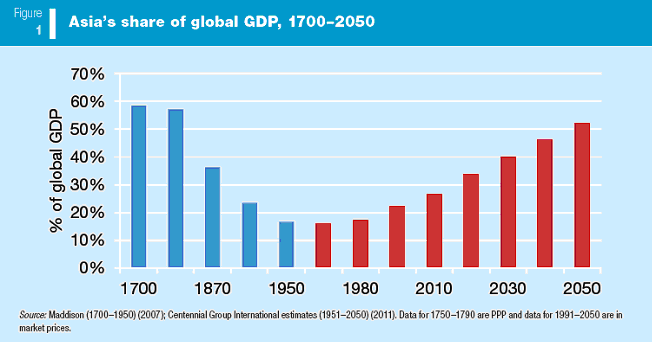
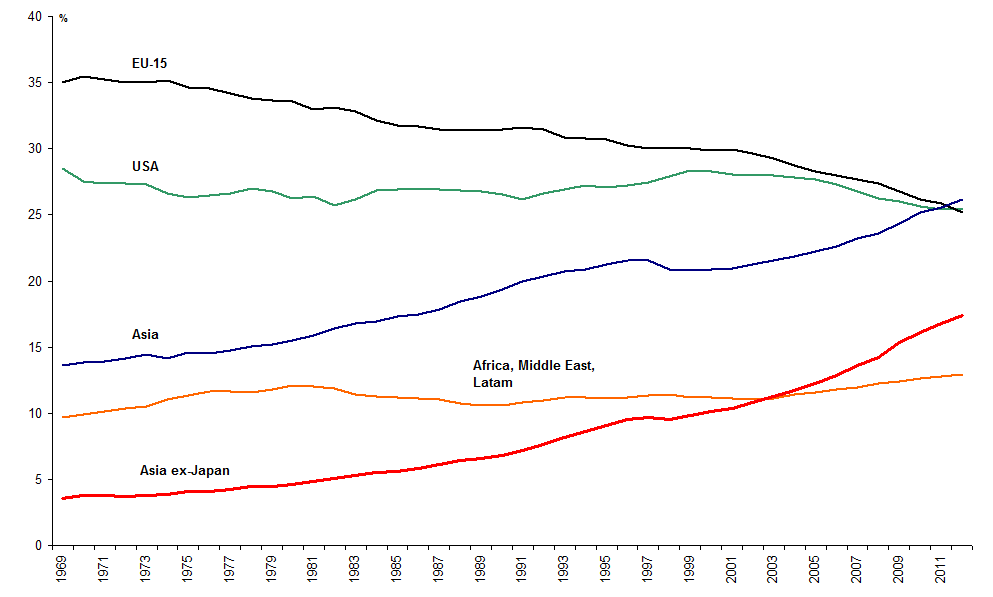
I recently came across two charts that tell an eloquent story.

The first is one that we have put together using data from the USDA. The chart shows the share of global GDP over the last 40-odd years. Asia has risen to rival USA and Europe in terms of GDP share: each of them contributes roughly a quarter of global GDP now. (The other stunning thing in the chart is the decline of Europe.)
Picture
The second one is even more striking. It comes from the excellent “Asia 2050” report published by the Asian Development Bank. Looking at a longer period in history, the chart shows the turnaround in Asia’s contribution to global GDP starting in mid-20th century. It looks about 40 years ahead and plots an increase to over 50% share of global GDP for Asia by 2050.
Picture
As the report puts it, Asia’s rise is not preordained. There are many challenges ahead. But if any one region has the potential to develop and grow, it is Asia!
0 Comments
Forward>>

    RSS Feed


    Author

    Dilip Parameswaran
    Twitter: @AsianCredit

    View my profile on LinkedIn

    Categories

    All
    Asia
    Asian Hard Currency Bonds
    Asian Hard Currency Bonds
    Bonds
    Books
    China
    Economics
    Equity
    High Yield
    High Yield
    India


    Archives

    September 2019
    January 2019
    May 2018
    January 2017
    September 2016
    May 2016
    January 2016
    November 2015
    August 2015
    June 2015
    March 2015
    February 2015
    January 2015
    November 2014
    October 2014
    September 2014
    June 2014
    March 2014
    January 2014
    November 2013
    October 2013
    September 2013
    July 2013
    June 2013
    May 2013
    April 2013


    Recent  posts

    FeedWind

    Like it? Share it!

Powered by Create your own unique website with customizable templates.